


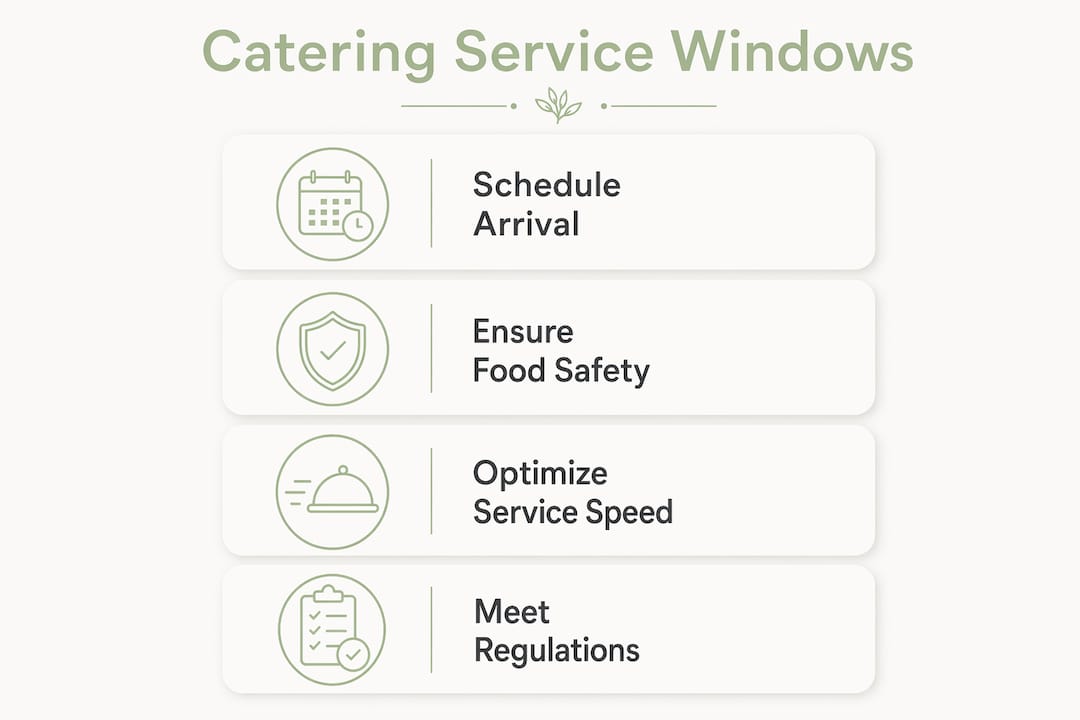
A catering service window is defined as either the scheduled arrival timeframe that guarantees timely, safe food delivery or the physical pass-through opening used to transfer food from kitchen to guest. Both meanings matter deeply to anyone planning a wedding, private party, or corporate event. Get either one wrong and you risk cold food, long lines, and a guest experience that falls short of what you envisioned. This guide covers both definitions, explains how they work together, and gives you the practical knowledge to plan your next event with confidence.
What is a catering service window in event planning?
A catering service window, in industry terms, refers to two distinct but related concepts: a delivery timing window and a physical service window. Understanding both is the foundation of smart event planning.
The timing window is the scheduled arrival interval that a catering team commits to for a specific event. It tells you exactly when the team will arrive, set up, and begin serving. This window protects food quality, satisfies health codes, and keeps your event on schedule.
The physical service window is the opening, typically built into a food truck, venue kitchen wall, or temporary structure, through which food passes from the preparation area to the guest-facing side. Both versions of the catering window definition serve the same ultimate goal: getting exceptional food to your guests at exactly the right moment.

Named entities like Paragon Logistics and Colorado Catering Company use both concepts together to coordinate arrival and execution for large-scale events. Desertdine applies the same discipline across weddings, private parties, and corporate events throughout the Greater Palm Springs area.
How do timing windows keep food safe and service reliable?
Timing is the backbone of professional catering logistics. A well-defined delivery window protects food quality from the moment it leaves the kitchen to the moment it reaches your guests.
Professional caterers follow a reverse-engineering approach to set service windows. Here is how that process works:
- Identify the guest serving time. Start with the exact moment food should be on the table or buffet.
- Add setup time. Factor in 20–30 minutes for chafing dishes, linens, and station arrangement.
- Add a buffer for delays. Logistics partners schedule arrival windows with 15–30 minute buffers for complex events to maintain compliance with hot holding and chilled transport standards.
- Account for venue access. Loading dock proximity, elevator wait times, and parking restrictions all affect the final arrival window.
- Confirm with the venue. Cross-check your window against the venue’s own schedule to avoid conflicts with other vendors.
Temperature control is the reason these buffers exist. Hot food must stay above 140°F and cold food below 40°F to meet food safety standards. Every minute outside those ranges increases risk. A clearly defined catering service delivery window eliminates guesswork and keeps your food at its best.
Pro Tip: Ask your caterer to share the specific arrival window in writing at least two weeks before your event. This gives you time to coordinate with your venue coordinator and avoid scheduling conflicts with photographers, florists, or entertainment.
What are the physical design and size standards for service windows?
Physical catering service windows are engineered openings designed to move food quickly, safely, and hygienically. They appear in food trucks, event venue kitchens, and temporary catering structures.
Standard sizes and materials
Standard service window sizes range from 24x24 inches to 60x36 inches, with 48x36 inches being the most common configuration for full-service catering operations. The size you need depends on your service volume and the type of food being passed through.
| Window Size | Best Use Case | Key Feature |
|---|---|---|
| 24x24 inches | Small private parties, limited menus | Compact, easy to secure |
| 36x24 inches | Mid-size events, single-line service | Balanced throughput |
| 48x36 inches | Full-service weddings and corporate events | High-volume, staff-friendly |
| 60x36 inches | Large-scale outdoor festivals or buffets | Maximum workflow capacity |
Materials matter as much as size. Aluminum frames resist corrosion in outdoor settings. Tempered glass panels protect food from wind and debris. Self-closing insect screens are required by most health departments to meet hygiene standards. Note that self-storing screens may fail codes in certain states, so always verify local requirements before installation.
Regulatory compliance
California’s Retail Food Code sets strict limits on physical service window openings. California food service windows must be limited to 216 square inches without an air curtain or 432 square inches with one to comply with health codes. Ignoring these limits can result in health department violations that shut down your service mid-event. If your event is in Palm Springs or anywhere in the Greater Desert region, confirm that your venue’s windows meet California standards before your event date.
Pro Tip: When touring a venue, bring a tape measure. Verify the service window dimensions yourself rather than relying on the venue’s spec sheet. A window that is two inches too small can create bottlenecks during peak service.
Properly sized and positioned physical service windows dramatically increase service speed and reduce staff fatigue during peak hours. That efficiency translates directly into a better experience for your guests.
How do service windows differ by event type and setup?
Not every event needs the same catering window configuration. The right setup depends on your guest count, venue layout, and service style.
- Walk-up windows work best for cocktail hours, outdoor garden parties, and casual corporate lunches. Walk-up service windows separate mobile orders to reduce congestion and maintain fast service speed. Guests approach, receive their dish, and move on without creating a bottleneck.
- Pass-through windows are ideal for plated dinners and formal weddings. The kitchen team plates each course and passes it through the window to servers, who then deliver to tables. This setup keeps the back-of-house completely separate from the dining area, preserving the atmosphere you worked hard to create.
- Drive-through configurations appear at large-scale corporate events or outdoor festivals where guests remain in vehicles or move through a defined lane. This format handles high volume quickly but requires significant space and traffic management.
- Indoor vs. outdoor setups carry different requirements. Outdoor windows need weatherproofing, insect screens, and sometimes shade structures to protect food. Indoor windows focus on workflow efficiency and staff ergonomics.
For weddings, Desertdine typically recommends a pass-through window setup paired with a clearly defined timing window of 90 minutes before the first course. This gives the team time to plate, arrange, and confirm temperatures before a single dish leaves the kitchen. For corporate event catering, a walk-up or buffet-style window often works better because it gives guests flexibility during shorter meal breaks.
The physical and timing windows work together. A perfectly designed physical window means nothing if the catering team arrives 45 minutes late. A precise arrival schedule means nothing if the physical window is too small to pass food through efficiently. Both elements must align for the event to run well.
How can event planners optimize their catering service windows?
Coordination between you, your venue, and your caterer is what turns a good event into a great one. These steps make that coordination concrete.
- Confirm the arrival window in your contract. Your catering agreement should specify the exact arrival time, setup duration, and first service time. Vague language like “early afternoon” creates problems. Specific language like “arrival by 3:30 PM, service begins at 5:00 PM” does not.
- Walk the venue with your caterer before the event. Identify the loading entrance, the distance from the kitchen to the service area, and any physical constraints that could slow setup. This single step prevents the majority of day-of surprises.
- Build buffer time into your event timeline. If dinner is scheduled for 7:00 PM, tell your caterer you need food ready by 6:45 PM. That 15-minute cushion absorbs minor delays without affecting your guests.
- Verify physical window compliance. If your venue uses a service window, confirm it meets local health codes. In California, this means checking against the 216 or 432 square inch limits depending on whether an air curtain is present.
- Communicate dietary and timing needs early. Menu customization affects how long food takes to prepare and plate. The more your caterer knows in advance, the tighter the service window can be.
Reliable catering service windows are commitments that increase trust between event planners and caterers by minimizing uncertainty. When both parties agree on a defined window, the entire event runs with less stress and more precision.
Pro Tip: Share your full event timeline with your caterer, not just the meal time. Knowing when speeches, toasts, and entertainment are scheduled helps the catering team anticipate natural pauses and serve at the perfect moment.
Key takeaways
A well-managed catering service window, whether a timing commitment or a physical opening, is the single most controllable factor in delivering exceptional food at any event.
| Point | Details |
|---|---|
| Two meanings, one goal | A catering service window is both a scheduled delivery timeframe and a physical food pass-through opening. |
| Buffer time is non-negotiable | Professional caterers pad arrival windows by 15–30 minutes to protect food safety and service reliability. |
| Physical size is regulated | California limits service window openings to 216 sq in without an air curtain and 432 sq in with one. |
| Event type drives window choice | Walk-up, pass-through, and drive-through windows each suit different event scales and service styles. |
| Early communication wins | Sharing your full event timeline with your caterer tightens the service window and reduces day-of stress. |
Why service windows are the detail most planners overlook
I have worked alongside catering teams at dozens of events, from intimate desert weddings to 300-person corporate dinners in Palm Springs. The detail that separates a smooth event from a chaotic one is almost never the menu. It is the service window.
Most planners focus on food selection, floral arrangements, and seating charts. Those matter. But I have watched a beautifully designed menu fall flat because the caterer arrived 40 minutes late with no buffer built into the schedule. The food was lukewarm, the guests were restless, and no amount of elegant plating fixed the impression.
The planners who get this right treat the service window as a contract, not a suggestion. They confirm it in writing, walk the venue in advance, and build real buffer time into the timeline. They also ask about the physical setup: Is the kitchen window large enough? Does it meet health codes? Is there a clear path from the loading area to the service station?
What I have found is that catering logistics done well are invisible to guests. They simply experience great food arriving at the right time. That invisibility is the goal. When the service window is defined, communicated, and respected, the entire event feels effortless. When it is ignored, everything else suffers.
— James
Plan your event with desertdine’s precision catering
Desertdine brings the same discipline to every event it serves across the Greater Palm Springs area. From the moment you confirm your booking, the team establishes a precise arrival window, coordinates with your venue, and prepares a customized menu that arrives at peak quality.
Whether you are planning a wedding reception in the desert, a private dinner party, or a corporate luncheon, Desertdine’s approach to catering service delivery means your guests experience every dish exactly as intended. Explore the full range of custom menu options or go straight to booking your event to get started. Desertdine handles the logistics so you can focus on celebrating.
FAQ
What does “catering service window” mean?
A catering service window refers to either the scheduled arrival and service timeframe a catering team commits to for an event or the physical opening through which food is passed from the kitchen to guests. Both definitions are used in professional event catering.
How long should a catering service window be?
Most professional caterers schedule arrival windows with a 15–30 minute buffer before the first service time to account for setup, temperature checks, and unexpected delays at the venue.
What size should a physical catering service window be?
Standard sizes range from 24x24 inches to 60x36 inches, with 48x36 inches being the most common for full-service events. California health codes cap openings at 216 square inches without an air curtain or 432 square inches with one.
Why does the catering service window matter for food safety?
Hot food must stay above 140°F and cold food below 40°F to meet safety standards. A defined delivery timing window keeps food within those ranges from preparation through service.
How do i confirm the service window with my caterer?
Request the exact arrival time, setup duration, and first service time in your catering contract. Walk the venue together in advance to identify any physical constraints that could affect the schedule.
Recommended
- Desert Dine Catering |What Is a Catering Event Brief? A Planner’s Guide• Palm Springs & Coachella Valley
- Desert Dine Catering |What Is a Catering Event Brief? A Planner’s Guide• Palm Springs & Coachella Valley
- Desert Dine Catering |How Catering Proposals Work: A Planner’s Guide• Palm Springs & Coachella Valley
- Desert Dine Catering |How Catering Proposals Work: A Planner’s Guide• Palm Springs & Coachella Valley


