


A well-timed wedding catering service flow is the difference between a reception guests remember fondly and one they describe as disjointed. The industry term for this is catering service choreography: the deliberate sequencing of food, drinks, and staff activity to match the rhythm of your wedding day. Every milestone, from staff arrival to late-night snacks, must align with speeches, toasts, and dancing to keep guests comfortable and the atmosphere alive. This guide gives you the exact timing benchmarks and planning phases you need to get it right.
What is the time wedding catering service flow and why does it matter?
A wedding catering service flow is the orchestrated schedule of every food and beverage moment across your reception. It covers when staff arrive, when cocktails are poured, when each course lands on the table, and when the final plates are cleared. Poor timing creates awkward silences, cold food, and restless guests. Good timing makes the meal feel like a natural part of the celebration rather than an interruption.
Catering flow success depends on timing every phase around the whole event choreography: ceremony, drinks, speeches, dinner, and dancing. Food should feel integrated, not isolated. When your caterer understands this, every course arrives at exactly the right moment in the emotional arc of your day.
Professional event coordinators build catering timelines starting with the dinner anchor block, then work backward to setup and service readiness milestones. That reverse-engineering approach is what separates a polished reception from a chaotic one.
When should catering staff arrive and how does preparation affect service flow?
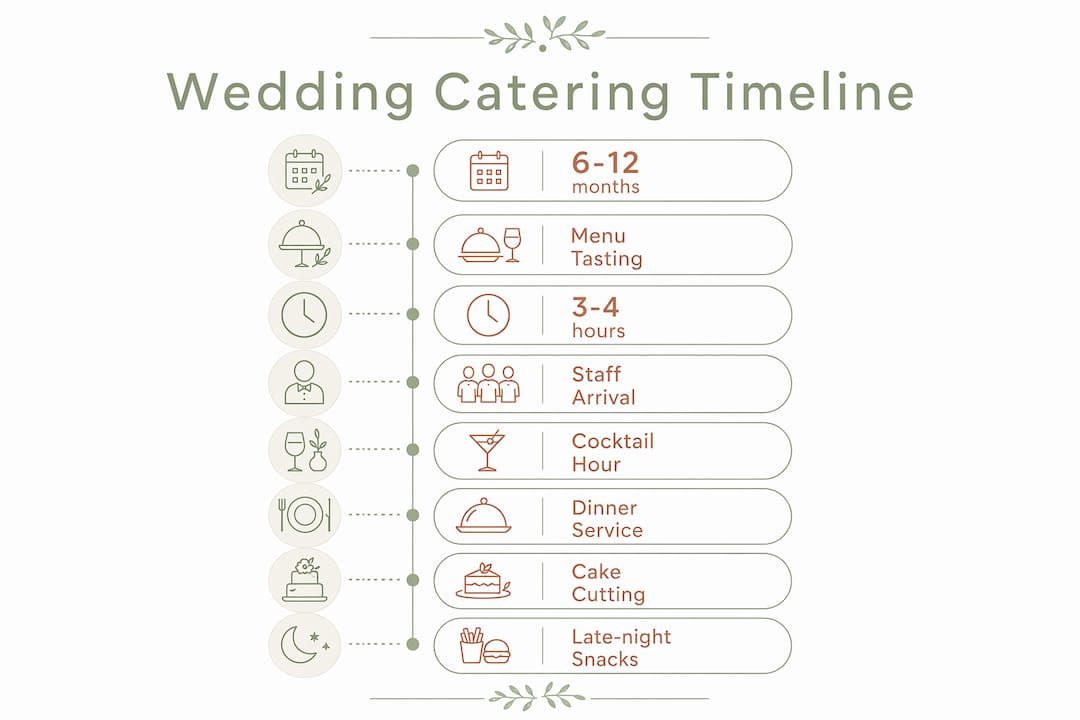
Catering staff should arrive 3–4 hours before the event starts. That window allows time for full kitchen setup, drink station readiness, table placement, and early troubleshooting. Elaborate menus or complex venues may require even earlier arrival.
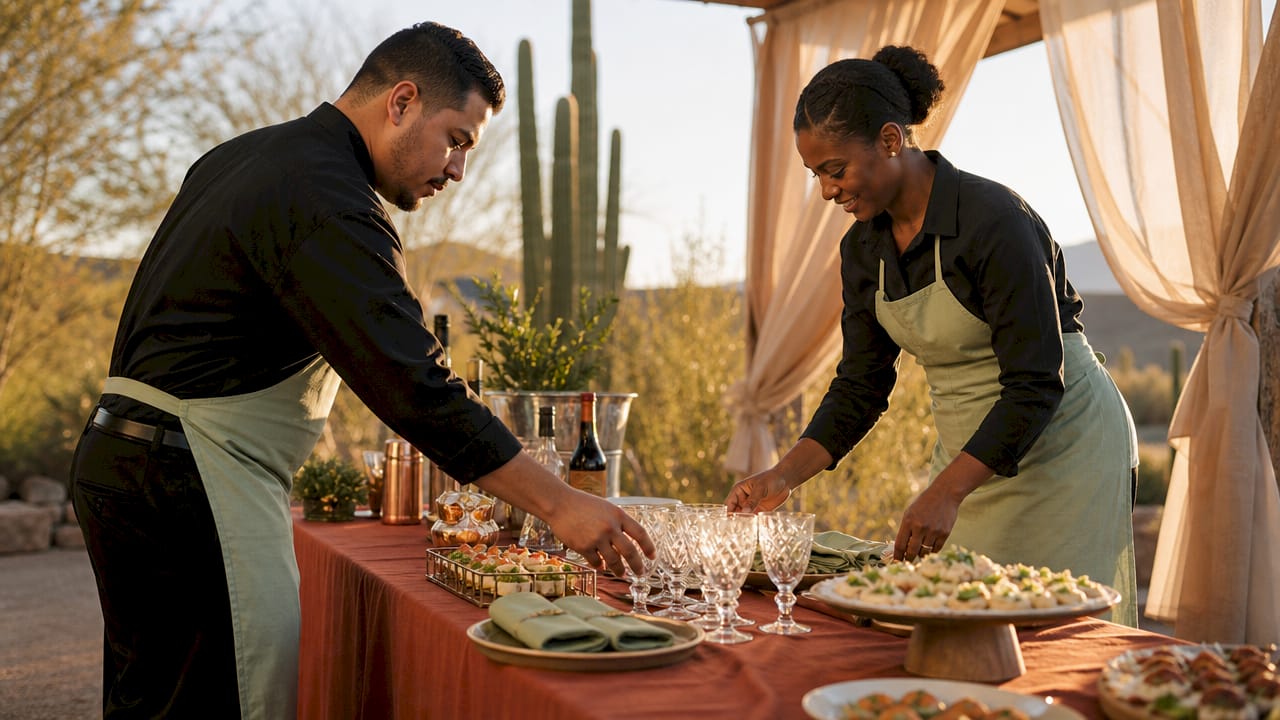
The behind-the-scenes work that happens before guests arrive is extensive. Access routes, load-in windows, equipment movement, and parking logistics all affect how smoothly setup runs. A venue with a single service elevator or a shared loading dock can add 30–45 minutes to setup time if not accounted for in advance.
Here is what a well-structured pre-service checklist looks like:
- Venue walkthrough: Confirm table layout, kitchen access, and power connections.
- Equipment setup: Chafing dishes, serving stations, and bar equipment placed and tested.
- Drink station readiness: Ice, glassware, and garnishes staged before the first guest arrives.
- Staff briefing: Every team member knows their station, timing cues, and point of contact.
- Contingency check: Backup supplies identified and accessible for common issues like spills or broken equipment.
Venue access restrictions and logistics significantly influence catering setup timing beyond just food service. Load-in routes, parking limits, and equipment movement must all be accounted for to avoid delays. Ignoring these details is the most common reason receptions start late.
Pro Tip: Ask your venue coordinator for the exact load-in window and share it with your caterer at least four weeks before the wedding. Even a 15-minute discrepancy between what the venue allows and what the caterer expects can cascade into a delayed cocktail hour.
What is the ideal timing for serving courses and drinks during the reception?
Pacing is the heart of a great catering service schedule. Guests who wait too long between courses lose energy. Guests who feel rushed lose the pleasure of the meal. The right intervals keep the room engaged without anyone watching the clock.
Follow this sequence for a standard multi-course wedding reception:
- Cocktail hour (30–60 minutes after ceremony ends): Canapés and drinks circulate as guests mingle. This window lets the couple complete photos while guests settle in.
- Seating and first course (within 15–20 minutes of guests being seated): Serving the first course within this window prevents the restlessness that builds when guests sit down with nothing in front of them.
- Entrée to main course gap (10–20 minutes): This pause allows conversation to breathe and gives the kitchen time to plate the main without rushing.
- Main course to dessert (20–30 minutes after main plates are cleared): Clearing plates signals a natural transition. Dessert arriving too quickly feels abrupt; waiting too long loses momentum.
- Late-night snacks (60–90 minutes before the reception ends): A second food moment near the dance floor gives guests a reason to stay energized through the final hour.
First food offers should happen within 30–60 minutes of guest arrival, with cocktails and canapés setting the tone before anyone sits down. That timing prevents the energy dip that happens when guests stand around with empty hands. Drinks should always precede food at each stage, signaling to guests that the next phase of the evening is beginning.
Pacing affects perception. Guests who feel well-fed and well-timed consistently rate receptions higher than those where the food was excellent but the timing was off. The meal is not just nutrition. It is a structural element of your event.
How to coordinate catering timing with wedding day events and formalities?
The biggest mistake couples make is treating catering as separate from the event program. Food service and formalities must be choreographed together. A speech that starts while servers are clearing plates creates noise and distraction. A cake cutting that happens before guests have digested dinner feels rushed.
Here is how to align your catering flow with key reception moments:
- Speeches and toasts: Schedule these between courses, not during them. The natural pause between the entrée and main course is the ideal window. Guests have food in their stomachs but empty plates in front of them.
- Cake cutting: Schedule cake cutting 30–60 minutes after dinner ends. This timing lets guests refocus and enjoy the moment without feeling like dessert is being rushed.
- First dance and dancing: Allow a 15–20 minute buffer between the last dinner course and the first dance. Guests need time to move from the table to the dance floor without feeling pushed.
- Late-night snacks: Dinner typically anchors the reception for 60–90 minutes. Late-night snacks served near the start of the open dance floor provide a second wind, maintaining energy into the night.
The table below shows how catering moments map to reception formalities in a typical five-hour reception:
| Reception moment | Catering action | Timing |
|---|---|---|
| Guest arrival | Cocktails and canapés served | First 30–60 minutes |
| Guests seated | First course delivered | Within 15–20 minutes |
| Between courses | Speeches and toasts | 10–20 minute gap |
| Dinner complete | Cake cutting | 30–60 minutes after dinner |
| Dance floor opens | Late-night snacks introduced | 60–90 minutes before end |
Protecting transition windows around speeches and plate clearing is the key to a smooth guest attention cycle. When your caterer and MC communicate in real time, these transitions feel natural rather than mechanical.
What are the major planning milestones for managing wedding catering?
A complete wedding catering timeline starts months before the wedding day. Booking popular caterers 6–12 months ahead is critical for securing your preferred vendor and date. Waiting until three months out significantly limits your options, especially for peak season weekends in destinations like Palm Springs.
| Planning phase | Timing | Key actions |
|---|---|---|
| Initial booking | 6–12 months before | Secure caterer, confirm date, discuss budget |
| Menu tasting | 6–9 months before | Finalize menu, confirm dietary needs, align with theme |
| Timeline planning | 1–3 months before | Lock in guest count, confirm service schedule |
| Vendor coordination | 2–4 weeks before | Share timeline with venue, DJ, photographer |
| Day-of execution | Wedding day | Staff arrival, setup, service, and clear-down |
Menu tasting at the 6–9 month mark is not just about flavor. It is the moment you confirm that your chosen dishes can be plated and served at the pace your timeline requires. A dish that takes 12 minutes per table to plate will create a bottleneck if your guest count is above 100. Your caterer should flag these constraints during the tasting.
The catering timeline from booking to breakdown includes detailed phases to maintain control and avoid last-minute problems. Post-event clear-down after guest departure deserves as much attention as setup. Venues with strict end times will charge overtime if your caterer is still breaking down equipment at midnight.
Pro Tip: Build your catering timeline in a shared document with your caterer, venue coordinator, and wedding planner. When everyone works from the same version, last-minute changes get communicated instantly rather than discovered on the day.
You can explore wedding catering menu styles to understand how different service formats, from plated dinners to family-style service, affect your timing needs at each phase.
How to troubleshoot common timing challenges in your catering flow?
Even well-planned receptions hit friction points. The most common timing problems are rushed courses, long waits between service moments, and poor coordination between the catering team and the MC or wedding planner. Each of these is preventable with the right approach.
A buffer-first mindset for catering setup and timing dramatically reduces the risk of disruptions caused by delays or unexpected challenges. Build 10–15 minutes of buffer into every major transition on your timeline. If the ceremony runs long, that buffer absorbs the delay without pushing dinner back.
Common timing challenges and how to address them:
- Rushed courses: Usually caused by a kitchen trying to compensate for a late start. The fix is earlier staff arrival and a realistic setup window, not faster service.
- Long waits between courses: Often a communication failure between the front-of-house team and the kitchen. Assign one person as the timing liaison between the caterer and the MC.
- Speeches running over: Build a 10-minute speech buffer into your timeline. Brief your MC to gently signal speakers when they approach their limit.
- Cake cutting delay: Confirm the cake cutting time with your baker, caterer, and photographer at least a week before the wedding. All three need to be in position simultaneously.
- Late-night snack timing: Introduce snacks when the dance floor is already active, not before. Guests who are dancing will welcome a food moment. Guests still at tables may interpret it as a signal the night is ending.
For a deeper look at how catering teams coordinate timing throughout the reception, the role of a catering captain is worth understanding. This person is your on-the-ground timing manager and the single most important hire for a smooth service flow.
Pro Tip: Do a verbal run-through of your full reception timeline with your caterer, MC, and wedding planner at least two weeks before the wedding. Talking through each transition out loud surfaces conflicts that a written timeline misses.
Key Takeaways
A precise wedding catering service flow requires coordinating staff arrival, course pacing, and formality timing as a single integrated plan rather than separate tasks.
| Point | Details |
|---|---|
| Staff arrival timing | Catering staff should arrive 3–4 hours early to complete setup and troubleshoot before guests arrive. |
| Course pacing benchmarks | Serve the first course within 15–20 minutes of seating; space courses 10–20 minutes apart. |
| Formality alignment | Schedule speeches between courses and cake cutting 30–60 minutes after dinner ends. |
| Advance planning | Book your caterer 6–12 months out and lock in the service timeline 1–3 months before the wedding. |
| Buffer mindset | Build 10–15 minute buffers into every major transition to absorb delays without disrupting the flow. |
What I have learned from watching receptions succeed and fail on timing
After years of working alongside catering teams at weddings across the Coachella Valley and Greater Palm Springs area, the pattern is clear. Couples who treat timing as a creative decision, not just a logistical one, have better receptions. They think about how a guest feels sitting at a table with an empty plate for 25 minutes. They think about the energy shift when late-night sliders hit the dance floor at exactly the right moment.
The couples who struggle are almost always the ones who finalized their catering timeline in the final two weeks. By then, the venue has its own schedule, the DJ has a set list, and the photographer has a shot list. Inserting catering timing at that stage means someone else’s plan gets disrupted.
The detail most couples underestimate is the gap between the ceremony and the first cocktail. Guests who wait more than 20 minutes for a drink after the ceremony ends start to feel neglected. That first glass of champagne or sparkling water is not just a beverage. It is a signal that the celebration has begun and that they are being taken care of.
My honest advice: treat your catering timeline as the backbone of your reception program. Every other element, from the first dance to the bouquet toss, should be scheduled around it. When food and drink flow well, guests relax. When guests relax, everything else feels better.
— James
Desertdine brings precision and warmth to your wedding catering
Planning a wedding in Palm Springs or the surrounding desert communities means working with a caterer who understands both the logistics and the experience. Desertdine specializes in full-service wedding catering with a focus on timing, flow, and locally sourced menus that reflect the beauty of the region.
From the first cocktail to the last late-night bite, Desertdine’s team manages every phase of your catering service schedule with care. Customizable menus, professional staff, and experienced coordination mean your reception runs exactly as planned. Book your event with Desertdine and start building a catering timeline that works for your day, your guests, and your vision. You can also explore custom menus designed to fit your timing and theme from the start.
FAQ
When should catering staff arrive for a wedding?
Catering staff should arrive 3–4 hours before the event begins. More complex menus or venues with access restrictions may require even earlier arrival.
How long should cocktail hour last before dinner?
Cocktail hour typically runs 30–60 minutes after the ceremony ends. This window gives guests time to mingle while the couple completes photos and the dining room is finalized.
When should the wedding cake be cut?
Cake cutting works best 30–60 minutes after dinner ends. This timing lets guests settle after the meal and gives the moment the attention it deserves.
How far in advance should you book a wedding caterer?
Book your caterer 6–12 months before the wedding to secure your preferred vendor. Schedule a menu tasting at the 6–9 month mark to finalize dishes and confirm service logistics.
What is the best time to serve late-night snacks at a wedding?
Late-night snacks are most effective when introduced 60–90 minutes before the reception ends, ideally when the dance floor is already active. This timing gives guests a second wind and encourages them to stay through the final hour.
Recommended
- Desert Dine Catering |Wedding Catering Menu Styles: Your 2026 Planning Guide• Palm Springs & Coachella Valley
- Desert Dine Catering |Wedding Catering Menu Styles: Your 2026 Planning Guide• Palm Springs & Coachella Valley
- Desert Dine Catering |How to Pair Catering with Your Wedding Theme• Palm Springs & Coachella Valley
- Full Service Wedding Catering | Desert Dine


