


Reducing food waste in corporate catering is defined as the practice of cutting surplus food production, overordering, and plate waste through data-driven planning, portion control, and responsible disposal. Data-driven waste systems can reduce food waste by 25–40% and lower food purchasing costs by 2–8%. That means a mid-size corporate catering program can recover tens of thousands of dollars annually while meeting ESG reporting goals. The strategies below give sustainability coordinators and event managers a practical, step-by-step path to measurable results.
How do accurate guest counts reduce food waste in corporate catering?
Accurate headcounts are the single most effective lever for cutting overproduction before it starts. Consumption rates vary sharply by event type: lunches consume roughly 85–90% of prepared food, while cocktail receptions consume only 60–70%. Ordering the same volume for both event types guarantees waste at one of them. Calibrating your order to the event format is the first step toward responsible catering practices.
Flexible ordering that allows headcount changes 48–72 hours before an event reduces waste significantly. Programs that lock orders weeks in advance tend to over-order because they cannot account for last-minute cancellations. Allowing late adjustments gives your catering partner accurate numbers to work with.
- Confirm final attendance 48–72 hours before the event, not at the time of booking.
- Segment your headcount by dietary preference so the caterer can allocate portions accurately.
- Request consumption data from past events to build realistic attendance projections.
- Communicate any schedule changes that affect meal timing, since delayed starts increase plate waste.
Pro Tip: Build a buffer of no more than 10% above confirmed attendance to cover no-shows. Buffers larger than 10% reliably produce surplus that ends up in the trash.
What menu design strategies minimize food waste at corporate events?
Menu design is a food waste reduction strategy, not just a culinary exercise. Reducing portion sizes for plated and family-style meals saved one venue nearly 3,000 pounds of food and $40,000 annually. That result came from a single, informed adjustment to serving sizes based on guest consumption habits. The financial case for portion control is direct and measurable.

Inclusive menus increase consumption and reduce wasted untouched portions. When vegan, gluten-free, and halal options are labeled and available as standard, guests with dietary restrictions eat fully instead of leaving food untouched. Dietary inclusion, planned as a standard menu component rather than a special request, cuts the volume of food that goes uneaten. You can explore how menu customization works to build this kind of flexibility into your next event.
Ingredient cross-utilization is a technique that most corporate event planners overlook. When a caterer designs menus so that the same base ingredients appear across multiple dishes, prep waste drops and leftover ingredients get used rather than discarded. Rotating menu items regularly also prevents menu fatigue, which causes repeat attendees to take less food and leave more behind.
- Use standard portion sizes based on consumption data, not intuition or tradition.
- Label all dietary options clearly: vegan, gluten-free, halal, nut-free.
- Design menus around shared base ingredients to reduce prep waste and surplus.
- Rotate offerings across recurring events to maintain attendance and plate completion rates.
Pro Tip: Standardize recipes with precise measurements and documented yields. Consistent recipes produce consistent portions, which makes waste forecasting far more accurate.
How to implement food waste tracking in catering operations
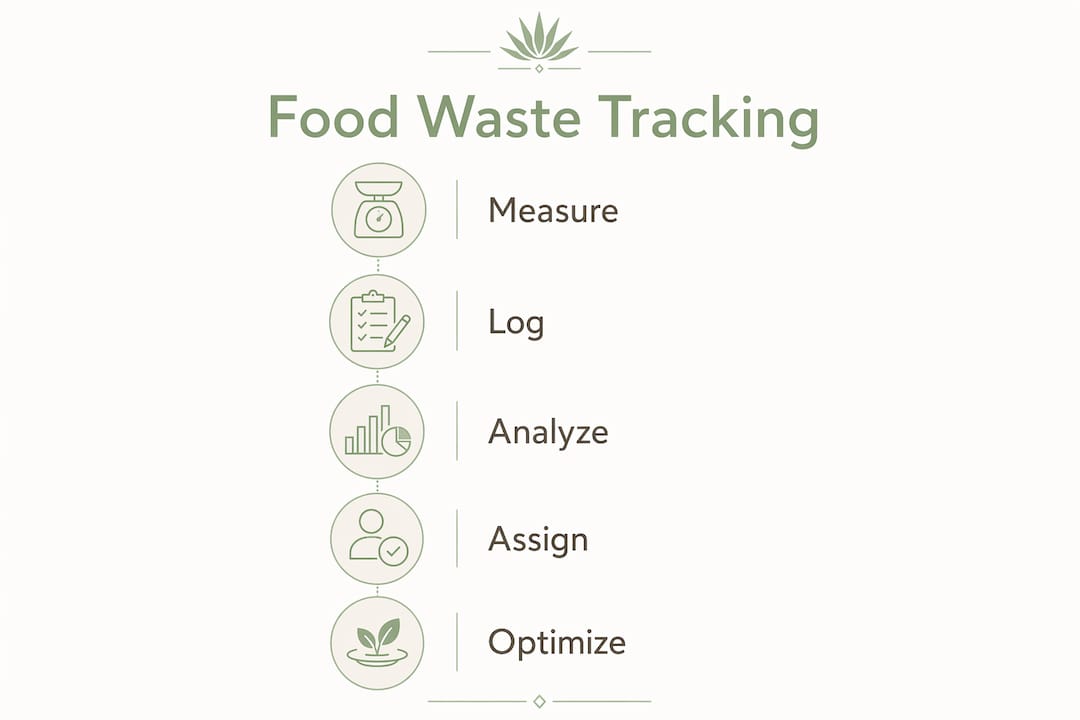
You cannot reduce what you do not measure. Tracking waste via visual logs or digital tools assigns accountability and highlights the cost impact of waste to kitchen and event teams. Waste tracking transforms waste management from a reactive cleanup task into a forward-looking planning tool.
Over-ordering causes 3–5% of food cost waste, overproduction accounts for 2–4%, and buffet overstock adds another 2–5%. Waste audits identify which of these categories is your biggest loss point. Targeting the right category first produces faster results than applying generic fixes across the board.
Follow this four-step process to build a tracking system:
- Separate waste categories. Track pre-consumer waste (prep scraps, overproduction) and post-consumer waste (plate waste) in separate logs. Mixing them hides where the real losses occur.
- Weigh and record. Use a kitchen scale and a simple log or a digital tool like Leanpath or Winnow to record waste by category after each event.
- Calculate the cost. Multiply waste weight by average food cost per pound. Presenting a dollar figure to management converts an abstract problem into a budget issue.
- Set targets and review monthly. A realistic starting target is a 20–30% reduction over six months. Review data monthly and adjust ordering or menu decisions based on what the numbers show.
| Waste Category | Typical Cost Impact | Primary Cause |
|---|---|---|
| Over-ordering | 3–5% of food cost | Early order lock-in |
| Overproduction | 2–4% of food cost | Inaccurate prep quantities |
| Buffet overstock | 2–5% of food cost | Full replenishment at service start |
Pro Tip: Assign a “waste champion” on your team to own the tracking process. One person with clear responsibility produces better data than a shared task that everyone deprioritizes.
Best practices for managing buffets to avoid excess waste
Buffet service produces the most visible and preventable food waste at corporate events. Starting buffets with about 60% of planned food and replenishing based on real-time consumption prevents the overproduction that comes from filling every tray at the start of service. This approach keeps presentations looking full while cutting the volume of food that never gets touched.
Smaller serving vessels are a practical tool that most event managers underuse. A half-full large tray looks depleted and prompts staff to refill unnecessarily. A full small tray signals abundance and requires less food to maintain that appearance. The visual effect is the same; the waste is not.
- Begin service with 60% of prepared food and replenish in small batches based on guest flow.
- Use smaller trays and serving vessels to maintain a full appearance with less food.
- Monitor guest flow actively and stop replenishment 30 minutes before the event ends.
- Remove uneaten items between courses at multi-course events to prevent overconsumption and spoilage.
Pro Tip: Train service staff on waste-conscious replenishment before every event. Staff who understand the goal make better real-time decisions than those following a fixed refill schedule.
How can surplus food be handled responsibly after corporate events?
Surplus food that cannot be served is not automatically waste. Establishing a relationship with a local food donation organization before your event means edible surplus has a destination the moment service ends. Many cities have food rescue nonprofits that accept same-day pickups from corporate events, provided food safety standards are met.
When donation is not feasible, an internal take-home program for staff is the next best option. Portioning surplus into labeled containers and offering them to catering and event staff reduces landfill volume and builds goodwill. For food that cannot be donated or taken home, composting is the responsible fallback. Set up clearly labeled compost bins and confirm access to a commercial composting facility before the event, since customized catering for corporate events often includes waste disposal planning as part of the service agreement.
- Partner with a food rescue organization and share your event calendar in advance.
- Offer a staff take-home program for portioned surplus when donation logistics are not possible.
- Set up labeled compost bins and verify commercial composting access before the event date.
- Avoid relying on compostable packaging alone without confirmed local compost infrastructure.
Pro Tip: Brief event staff on food disposal guidelines at the pre-event walkthrough. Clear instructions at the start prevent confusion and contamination at the end of service.
Key Takeaways
Reducing food waste in corporate catering requires precise headcounts, portion-controlled menus, active waste tracking, and a clear plan for surplus disposal.
| Point | Details |
|---|---|
| Confirm headcounts late | Lock final attendance 48–72 hours before the event to minimize over-ordering. |
| Design menus for inclusion | Label dietary options as standard to increase consumption and reduce untouched portions. |
| Track waste by category | Separate pre-consumer and post-consumer waste to identify and target the biggest loss points. |
| Start buffets at 60% | Begin service with 60% of food and replenish in real time to prevent buffet overstock. |
| Plan surplus disposal | Establish donation or composting partnerships before the event, not after service ends. |
What I’ve learned about making waste reduction actually stick
The biggest obstacle to reducing catering waste is not logistics. It is the fear of running out. I have watched event managers approve orders 30% above confirmed attendance because they were more afraid of an empty tray than a full trash bin. That fear is understandable, but it is also the single most expensive habit in corporate catering.
The shift that actually works is treating food waste as a design problem rather than an operational failure. When you plan the menu, the portion sizes, the buffet replenishment schedule, and the surplus disposal before the event starts, waste becomes a variable you control rather than a result you apologize for. The catering menu engineering principles that drive profitability are the same ones that drive waste reduction. They are not in conflict.
Data is what makes the cultural shift permanent. When a team sees that over-ordering cost $4,200 last quarter, the conversation changes. Waste stops being abstract and starts being a line item. Empowering your catering team with that data motivates sustainable habits far more effectively than policy memos or sustainability pledges. Small operational changes, confirmed headcounts, smaller buffet trays, a waste log, compound into significant savings over a full event calendar.
— James
Desertdine’s approach to corporate catering and waste reduction
Corporate sustainability goals deserve a catering partner who plans for them from the start. Desertdine builds every corporate event menu around accurate portion planning, ingredient cross-utilization, and flexible headcount adjustments that reduce surplus without reducing quality.
Desertdine’s team works with sustainability coordinators and event managers across the Greater Palm Springs area to align catering programs with ESG reporting needs. From custom event menus designed for dietary inclusion to last-minute headcount flexibility, every detail is planned to minimize waste and maximize the guest experience. If your next corporate event needs a catering partner who treats sustainability as a standard, not an add-on, book your event with Desertdine today.
FAQ
How much can corporate catering waste be reduced?
Data-driven systems can reduce food waste by 25–40% and cut purchasing costs by 2–8%. Results depend on how consistently headcount data, portion standards, and tracking protocols are applied.
When should final headcounts be confirmed for catering orders?
Confirm final attendance 48–72 hours before the event. Flexible ordering that allows late adjustments reduces waste significantly compared to locking orders weeks in advance.
What is the best way to handle buffet waste at corporate events?
Start buffet service with 60% of planned food and replenish in small batches based on real-time guest flow. Use smaller serving vessels to maintain a full appearance without overstocking.
Does menu design really affect food waste levels?
Yes. Portion size reductions at one venue saved nearly 3,000 pounds of food and $40,000 annually. Inclusive menus with labeled dietary options also reduce untouched portions significantly.
What should happen to surplus food after a corporate event?
Redirect edible surplus to a food rescue organization, offer it to staff through a take-home program, or compost it through a verified commercial facility. Confirm your disposal plan before the event, not after service ends.
Recommended
- Desert Dine Catering |What Is Corporate Catering Service? A Business Guide• Palm Springs & Coachella Valley
- Desert Dine Catering |5 Ways Food Can Encourage Networking at Your Corporate Event - What to Know• Palm Springs & Coachella Valley
- Desert Dine Catering |4 Benefits of Hiring a Caterer for Your Corporate Event - What to Know• Palm Springs & Coachella Valley
- Desert Dine Catering |Corporate Holiday Gifting Catering Options for Offices• Palm Springs & Coachella Valley


