


Catering is the most visible expression of executive hospitality standards at any corporate event. The food, service timing, and staff conduct communicate your organization’s values before a single agenda item is discussed. Attendees perceive catering as a primary factor in overall event professionalism, not simply as nourishment. When catering excellence in hospitality is executed well, it shapes guest engagement, protects meeting flow, and signals that every detail has been considered. This article covers the operational standards, etiquette practices, and menu design principles that define high-caliber executive catering.
How catering reflects executive hospitality standards through safety protocols
Food safety is not a back-of-house concern. It is a direct reflection of organizational competence. The foundation of professional catering operations is the Hazard Analysis and Critical Control Points framework, known as HACCP. Every reputable caterer applies a HACCP plan tailored to the specific event, covering transport conditions, on-site storage, allergen management, and temperature logging.
Food held between 40°F and 140°F for more than two hours enters the bacterial growth danger zone. That window is tighter than most executives realize, and it applies to every course at every service point. A single temperature failure at a multi-day leadership retreat can compromise guest health and the organization’s reputation simultaneously.
Event-specific checklists covering venue logistics, headcount, allergens, and temperature records serve as legally defensible documentation of HACCP compliance. These checklists are not administrative formalities. They are the proof that a caterer operates at a professional standard.
Here is what a complete event safety checklist covers:
- Transport time logs: documented departure and arrival times with temperature readings at each stage
- Venue infrastructure assessment: available refrigeration, power sources, and prep space confirmed before the event date
- Allergen mapping: each menu item labeled with allergen content, with parallel options prepared in separate equipment
- Headcount flexibility: a documented process for adjusting food volume when attendance changes at the last minute
- Temperature monitoring: continuous logs from kitchen to service point, with corrective action steps defined in advance
Professional caterers must adjust food volume swiftly when headcount fluctuates across multi-day events. That flexibility requires preparation, not improvisation.
Pro Tip: Ask your caterer for a copy of their event-specific HACCP checklist before confirming any booking. A provider who cannot produce one is not operating at executive hospitality standards.
What executive catering etiquette looks like in practice
Catering etiquette in executive settings is a timing discipline. Service that arrives too early interrupts a presentation. Service that arrives too late breaks momentum and signals poor coordination. The goal is for catering to function as a timed layer beneath the meeting agenda, invisible until the moment it is needed.
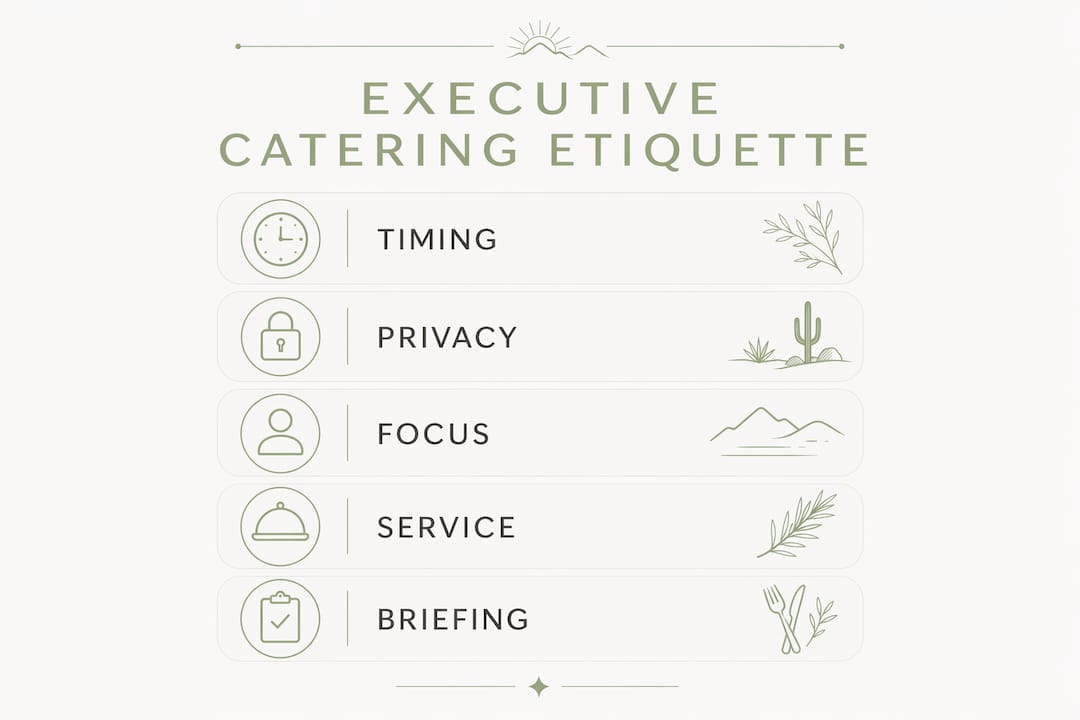
Catering etiquette controls time, privacy, and focus by aligning service to natural breaks and minimizing staff movement during active sessions. In high-stakes negotiations, catering can also act as a control mechanism, allowing the host to manage the room’s tone and protect the privacy of sensitive conversations. A well-timed coffee break, for example, gives both sides a moment to recalibrate without breaking the meeting’s formal structure.
The service format matters as much as the timing. Seated or boxed meal formats are preferred over buffets in high-stakes settings because buffets create movement that fragments attention and breaks room energy. A boxed lunch served at the table keeps executives in their seats and the conversation on track.
Follow this sequence to build etiquette into your event plan:
- Share the full meeting agenda with your caterer at least 72 hours before the event.
- Mark every natural break point where service can enter and exit without disrupting flow.
- Confirm that staff will use designated entry and exit routes away from the main meeting area.
- Specify noise limits: no clattering trays, no loud verbal confirmations, no equipment on wheels near the meeting room.
- Assign one catering point of contact to communicate directly with the event coordinator throughout the day.
Pro Tip: Brief your catering staff on the meeting’s subject matter at a high level. Staff who understand the context of an event are far less likely to make disruptive choices during service.
What menu design principles signal high hospitality standards?
Menu design at the executive level is a brand statement. The food you serve communicates how much thought you have given to your guests’ experience, comfort, and productivity. Generic buffet spreads with heavy carbohydrates signal that catering was an afterthought. A curated, multi-course menu with locally sourced ingredients signals that the event was planned with intention.

High-end corporate catering menus feature mess-free formats that allow guests to keep their hands free for networking and note-taking. Formats like single-bite canapés, individually plated starters, and elegant finger foods remove the awkwardness of eating while talking. A truffle-infused tartare cone, for example, delivers a sophisticated flavor experience without requiring utensils or a plate, making it ideal for a standing reception before a board dinner.
Functional food choices also matter. Menus built around lean proteins, complex carbohydrates, and fresh vegetables sustain energy and mental clarity across long meeting days. Heavy, rich dishes served at midday cause the post-lunch energy drop that derails afternoon sessions. A well-designed executive menu accounts for cognitive performance, not just taste.
Key menu design principles for executive hospitality events:
- Mess-free formats: prioritize foods that can be eaten without utensils or that require minimal handling
- Allergen transparency: label every item clearly and offer parallel options that do not require guests to ask
- Locally sourced ingredients: farm-to-table sourcing signals quality and supports a positive brand image
- Flavor balance: avoid overpowering spices or strong aromas that linger in a closed meeting room
- Visual presentation: plating and display quality should match the formality of the event
You can review a detailed catering menu checklist before confirming your event menu to make sure nothing is overlooked.
How does strategic catering execution shape event perception?
Execution is where catering plans either hold together or fall apart. A menu can be exceptional and a HACCP plan can be thorough, but poor coordination on the day destroys the impression both were designed to create. Strategic execution means mapping catering checkpoints directly to agenda milestones and building in contingency at every stage.
Treating catering as a timed layer under the agenda, with defined service checkpoints, prevents the most common executive annoyances: staff arriving mid-presentation, dishes cleared before guests finish, or coffee running out during a critical session break. Each of these moments is small in isolation. Together, they define how guests remember the event.
For venues without full kitchen infrastructure, mobile kitchen units or on-site production setups allow caterers to maintain food quality and temperature control regardless of location. This is particularly relevant for executive retreats held at desert properties, private estates, or outdoor venues in the Greater Palm Springs area.
Consistency across multi-day events requires a documented service schedule, not just a general plan. Each day’s service should mirror the previous day’s timing and quality unless the agenda explicitly changes. Guests notice inconsistency. A lunch that was prompt and beautifully presented on day one sets an expectation that must be met on day two.
| Execution risk | Prevention approach |
|---|---|
| Staff entering during active sessions | Designate entry windows tied to agenda break times |
| Food temperature dropping before service | Use insulated transport and on-site holding equipment |
| Headcount changes disrupting portions | Build a 10–15% volume buffer into every service |
| Noise from equipment or staff | Conduct a venue walkthrough to identify quiet routes |
| Inconsistency across multi-day events | Use a written service schedule reviewed each morning |
What measurable impact does catering quality have on executive events?
Corporate events are judged holistically, and catering deeply influences perceptions of professionalism and organizational success. Guests do not separate the food from the event. They experience both as a single impression. A poorly executed catering service at a leadership summit signals that the organizing team lacks attention to detail, regardless of how strong the content was.
Catering also directly supports networking outcomes. When food is easy to eat, elegantly presented, and served at the right moment, guests are free to focus on conversation and relationship building. When food is awkward, delayed, or poorly labeled, guests spend mental energy managing the situation instead of engaging with each other.
“In executive meetings, catering etiquette acts as a control mechanism, allowing hosts to shield negotiation tone and maintain privacy.” — Executive Events Without Friction
This insight reframes catering from a logistical function to a strategic tool. Hosts who understand this use catering timing and format to manage room dynamics, not just to feed guests. For executives planning high-stakes meetings, that distinction is worth building into every event brief.
The return on investment from quality catering shows up in guest satisfaction, post-event feedback, and the likelihood that attendees leave with a positive impression of the organizing company. You can find more detail on impressing clients through catering and how those impressions translate into business outcomes.
Key Takeaways
Executive catering excellence requires HACCP compliance, precise service timing, and menu design that supports both guest comfort and cognitive performance across every event.
| Point | Details |
|---|---|
| Safety standards are non-negotiable | HACCP plans and temperature logs protect guest health and demonstrate organizational competence. |
| Timing defines etiquette | Catering aligned to agenda break points prevents disruptions and maintains meeting focus. |
| Menu design is a brand signal | Mess-free, locally sourced, allergen-labeled menus communicate care and professionalism. |
| Execution requires documentation | Written service schedules and contingency buffers prevent inconsistency across multi-day events. |
| Catering shapes event ROI | Guest impressions of professionalism are directly tied to catering quality and execution. |
What I have learned from years of executive event catering
The biggest mistake I see organizations make is treating catering as a separate vendor relationship rather than an integrated part of event planning. They finalize the agenda, book the venue, and then call a caterer two weeks out expecting everything to fall into place. It rarely does.
The executives I have worked with remember two things after a corporate event: what was said in the room and how they felt while they were there. Catering controls the second half of that equation more than most people realize. A room that smells like fresh food, where service is quiet and well-timed, and where every dietary need has been anticipated without anyone having to ask, creates a physical sense of being cared for. That feeling transfers directly to how guests perceive the organizing company.
My strongest recommendation is to bring your caterer into the planning process at the same time you finalize your agenda. Share the session structure, the attendee list, and any known dietary requirements from the start. The caterers who operate at the highest level, including the team at Desertdine, treat that early briefing as the foundation of everything that follows. The ones who do not ask for it are telling you something important about how they work.
One trend worth watching in 2026 is the shift toward hyper-local sourcing at executive events. Guests are increasingly aware of where food comes from, and a menu built around ingredients from the host region signals both quality and thoughtfulness. For events in the Palm Springs area, that means desert-grown produce, local artisan suppliers, and menus that reflect the character of the location. It is a detail that costs little extra but lands with guests in a way that generic catering never does. You can read more about setting catering standards at luxury properties for a deeper look at how this approach works in practice.
— James
Desertdine’s approach to executive event catering
Desertdine brings full-service corporate catering expertise to executive events across the Greater Palm Springs area, with capabilities that match every standard covered in this article.
Desertdine’s corporate catering programs include HACCP-compliant food handling, event-specific safety documentation, customizable menus built around locally sourced ingredients, and service teams briefed to operate with discretion and precision. Whether you are planning a single-day leadership summit or a multi-day executive retreat, Desertdine designs every service detail around your agenda. Explore catering package options or go directly to book your event to start the conversation.
FAQ
What is the bacterial danger zone in catering?
The bacterial danger zone is the temperature range between 40°F and 140°F. Food held within this range for more than two hours poses a health risk and must be discarded.
Why are buffets avoided at executive events?
Buffets create attendee movement that breaks meeting focus and room energy. Seated or boxed meal formats keep guests in place and maintain the meeting’s professional tone.
What does a HACCP plan cover for catered events?
A catering HACCP plan covers transport temperature logs, allergen management, venue infrastructure, headcount adjustments, and corrective action steps. It serves as a legally defensible record of food safety compliance.
How does menu design affect executive hospitality?
Menu design communicates organizational values through food quality, presentation, and format. Mess-free, allergen-labeled, locally sourced menus signal care for guests and reflect positively on the hosting company.
When should a caterer be brought into event planning?
A caterer should be engaged at the same time the event agenda is finalized. Early briefing on session structure, attendee count, and dietary needs allows the catering team to build a service plan that integrates with the meeting flow.
Recommended
- Desert Dine Catering |How to Impress Clients at an Executive Catering Event• Palm Springs & Coachella Valley
- Desert Dine Catering |Types of High-End Catering Presentations for Events• Palm Springs & Coachella Valley
- Desert Dine Catering |Catering’s role in planning a great conference• Palm Springs & Coachella Valley
- Desert Dine Catering |Corporate Award Dinner Catering Elements: 2026 Guide• Palm Springs & Coachella Valley


