


Catering menu engineering is defined as the structured analysis of each menu item’s popularity and profitability to maximize revenue and guest satisfaction across every event type. Unlike restaurant menus, catering menus face unique constraints: fixed-price packages, batch production, and the need to serve hundreds of guests with consistent quality. A data-driven menu approach applies catering menu engineering principles to turn guesswork into measurable results. Caterers who implement these principles report profit lifts between 10% and 23% within 90 days of full implementation. That kind of gain comes from treating your menu as a financial instrument, not just a food list.
1. What are catering menu engineering principles?
Menu engineering is often misunderstood as menu design. It is fundamentally financial and operational analysis that informs every design choice you make afterward. The core concept rests on two variables for every dish: how often guests choose it (popularity) and how much profit it generates (contribution margin). Contribution margin equals the selling price minus the food cost for that item. When you map every dish on those two axes, you get a clear picture of where your menu is earning and where it is bleeding margin.
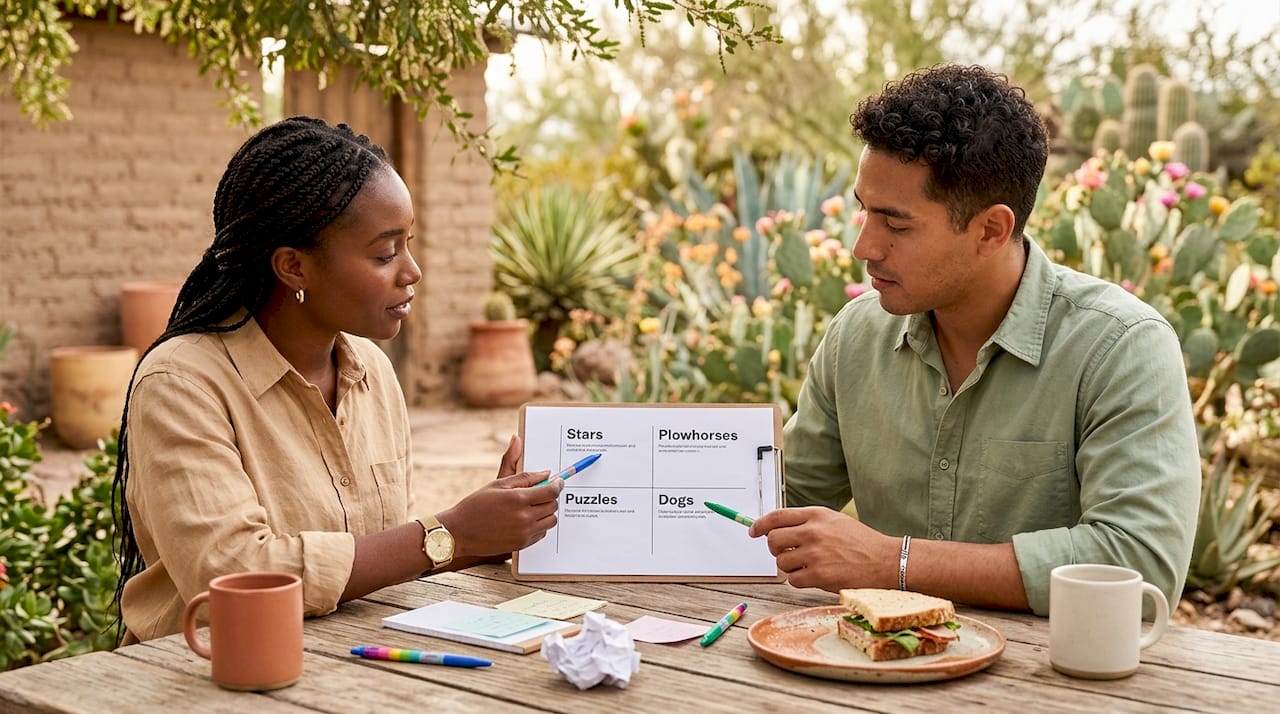
The four categories that emerge from this matrix are Stars, Plowhorses, Puzzles, and Dogs. Each category demands a different response. Knowing which dish belongs where is the starting point for every other decision you make about your catering offerings.
2. How to categorize dishes using the popularity-profitability matrix
Professional caterers define a popular dish as one selected over 30% of the time and a profitable dish as one yielding over 65% contribution margin. Those two thresholds create four actionable quadrants.
1. Stars (high popularity, high margin) Feature these dishes prominently. Place them in the visual prime spots on your menu and train your event sales team to recommend them first. Stars are your financial foundation.
2. Plowhorses (high popularity, low margin) Guests love these dishes, but they cost you. Reduce portion size slightly, swap one ingredient for a lower-cost alternative, or bundle them with a higher-margin side. The goal is to protect guest satisfaction while recovering margin.
3. Puzzles (high margin, low popularity) These dishes make money when ordered but rarely get chosen. The fix is presentation and placement. Better descriptions, stronger naming, and prime menu real estate can shift a Puzzle toward Star status.
4. Dogs (low popularity, low margin) Remove them or completely re-engineer them. Keeping Dogs on a catering menu wastes kitchen capacity and confuses guests. In fixed-price catering, every slot on the menu costs you production resources.
Pro Tip: Calculate contribution margin per dish before your next event cycle. A simple spreadsheet with selling price, food cost, and number of portions served gives you the data you need to categorize every item accurately.
Fixed-price catering packages change the dynamic slightly. You cannot raise the price of a single dish, so the only lever you control is cost. That makes contribution margin tracking per dish even more critical in catering than in a la carte restaurant settings.
3. Menu design strategies that guide guests toward profitable choices
Menu engineering must precede design. Once your financial analysis is complete, visual psychology amplifies the results. The goal is to guide guests toward your Stars and Puzzles without them realizing it.
The Golden Triangle eye-tracking pattern shows that guests’ eyes move first to the center of a menu, then to the upper right, then to the upper left. Those three zones are prime real estate. Place your highest-margin items there. This principle applies whether you are presenting a printed event menu or a digital catering proposal.
Here are the most effective visual tactics for catering menus:
- Use boxes and shading to highlight Stars and Puzzles. Highlighting techniques increase selection rates by 20% to 30%.
- Remove currency symbols from pricing columns. Dropping the dollar sign can increase average spend by 8% or more.
- Limit each category to around seven items. Fewer choices reduce decision fatigue for guests and simplify kitchen workflow during high-volume events.
- Write descriptive names for Puzzles. “Slow-roasted herb chicken with lemon caper butter” outperforms “Herb Chicken” every time.
- Use white space deliberately. A clean layout signals quality and makes featured items stand out.
Pro Tip: For multi-course event menus, use a single-page format when possible. Single-page menus keep guests focused and reduce the chance they skip past your high-margin offerings.
| Design element | Effect on guest behavior |
|---|---|
| Boxes and color shading | Increases item selection by 20–30% |
| Removing currency symbols | Raises average spend by 8% or more |
| Seven items per category | Reduces decision fatigue and speeds service |
| Golden Triangle placement | Directs attention to high-margin items first |
| Descriptive dish names | Improves Puzzle item selection rates |
Catering professionals who apply these visual menu psychology tactics consistently report stronger client satisfaction scores alongside improved per-event margins.
4. Operational considerations unique to catering batch production
Catering menu optimization differs from restaurant menu engineering in one critical way: you are producing food in large batches for a fixed price, not cooking to order. That constraint shapes every menu decision you make.
Catering requires a modular system mindset that centers on batch production, service tempo, and protecting margins within fixed-price offerings. A modular menu groups dishes by shared base ingredients and preparation methods. One roasted vegetable base, for example, can support three different finished dishes. That approach cuts prep time, reduces waste, and protects your food cost.
Key operational principles for catering menus:
- Protect kitchen flow. Every item you add to a catering menu adds a production step. Limit menu complexity to what your team can execute consistently at volume.
- Track contribution margin per dish even in fixed-price contracts. You cannot change the package price, but you can adjust ingredient quality, sourcing, or portion weight to recover margin on Plowhorses.
- Plan for dietary options without disrupting production. Build vegetarian and allergen-friendly dishes from the same base ingredients as your standard offerings. This keeps kitchen flow clean and avoids separate production lines.
- Align menu design with service tempo. A buffet menu and a plated dinner menu require different item counts, preparation windows, and staffing ratios. Engineer each format separately.
- Integrate sales and kitchen feedback. Your event sales team hears what clients want. Your kitchen team knows what they can produce efficiently. Menu decisions made without both inputs create operational problems.
Understanding boxed lunch versus buffet formats also affects how you structure menu categories and portion sizes. Each service style has different margin profiles and production demands.
5. How to measure and iterate catering menu performance
Menu engineering is a cycle, not a one-time project. The best catering operations review performance after every 10 events to catch shifts in popularity or profitability before they erode margins.
Here is a practical iteration process:
- Track portion disappearance rates. If a dish consistently comes back with leftovers, it is trending toward Dog status regardless of what your initial analysis showed.
- Collect guest feedback after every event. Direct client comments and post-event surveys reveal preference shifts that sales data alone cannot capture.
- Analyze waste ratios. High waste on a specific dish signals either over-portioning or low popularity. Both hurt your margin.
- Promote Stars consistently. Feature them in every proposal, every menu presentation, and every client conversation. Stars earn their prominence.
- Eliminate Dogs early. Keeping a low-performing dish on your menu costs kitchen time, ingredient budget, and menu real estate. Cut it before it compounds the loss.
- Update menus on a defined schedule. A quarterly review cycle works well for most catering operations. More frequent reviews make sense after major event seasons.
Tracking portion disappearance and waste ratios gives you the clearest signal of true guest preference under fixed-price conditions. Software tools like spreadsheet-based dashboards or dedicated food cost platforms make this tracking manageable even for smaller catering teams. A well-structured pre-event menu checklist also helps you capture the right data points before service begins.
Key takeaways
Effective catering menu engineering combines contribution margin analysis, behavioral psychology, and operational discipline to produce measurable profit gains and stronger client satisfaction at every event.
| Point | Details |
|---|---|
| Matrix categorization drives decisions | Classify every dish as Star, Plowhorse, Puzzle, or Dog before making any menu changes. |
| Visual design amplifies financial analysis | Place high-margin items in the Golden Triangle and use boxes and shading to increase selection rates. |
| Batch production demands modular menus | Design menus around shared base ingredients to protect margins and maintain kitchen flow at volume. |
| Iteration is the real competitive edge | Review performance metrics after every 10 events to catch profitability shifts before they compound. |
| Fixed-price contracts require cost control | Adjust portions and ingredient sourcing to protect contribution margin when package pricing is locked. |
What I have learned from applying menu engineering in real events
The biggest mistake I see catering professionals make is treating menu engineering as a design project. They spend hours on layout and typography before they have run a single contribution margin calculation. The result looks polished but performs poorly because the financial foundation was never built.
The second pitfall is variety for its own sake. Clients often ask for more options, and the instinct is to say yes. But every item you add to a catering menu creates a production burden. I have seen kitchen teams buckle under menus with 20-plus items per course, and the guest experience suffers for it. Limiting categories to around seven items is not a constraint. It is a quality decision.
The most rewarding shift happens when you bring your kitchen team, sales team, and event planners into the same conversation about menu performance. When those three groups share data and speak the same language around Stars and Plowhorses, menu updates happen faster and with far less friction. That collaboration is where the real gains come from.
— James
Desertdine’s approach to menu engineering for your event
Desertdine applies data-driven menu engineering to every catering program it builds for clients across the Greater Palm Springs area. Each menu is designed around contribution margin analysis, guest preference data, and the operational realities of the event format.
Whether you are planning a corporate event in Palm Springs or a bespoke private gathering, Desertdine’s team builds menus that balance what guests love with what makes financial sense. The result is a curated, profitable offering that feels effortless to your guests and efficient for your kitchen. Explore Desertdine’s customizable event menus or book your event to start building a menu engineered for results.
FAQ
What is the catering menu engineering concept?
Catering menu engineering is the structured analysis of each dish’s popularity and contribution margin to guide menu design, pricing, and item selection for maximum profitability across events.
How do you calculate contribution margin for catering dishes?
Subtract the food cost of a dish from its selling price. A dish yielding over 65% contribution margin qualifies as profitable under standard catering menu engineering thresholds.
How many items should a catering menu category include?
Limiting each category to around seven items reduces decision fatigue for guests and improves kitchen workflow, making it the recommended ceiling for most catering event formats.
How often should catering menus be reviewed for performance?
Top catering operations review menu performance after every 10 events to identify shifts in popularity or profitability and update offerings before margin erosion occurs.
What is the difference between a Star and a Plowhorse on a catering menu?
A Star is both popular and profitable. A Plowhorse is popular but generates a low contribution margin, requiring cost adjustments to protect overall event profitability.
Recommended
- Desert Dine Catering |How Menu Customization Works in Catering for Events• Palm Springs & Coachella Valley
- Desert Dine Catering |How Private Catering Menus Are Built for Any Event• Palm Springs & Coachella Valley
- Desert Dine Catering |How Catering Trends Shape Hospitality Menus in 2026• Palm Springs & Coachella Valley
- Desert Dine Catering |How Catering Proposals Work: A Planner’s Guide• Palm Springs & Coachella Valley


